
"DANGER, WILL ROBINSON!"

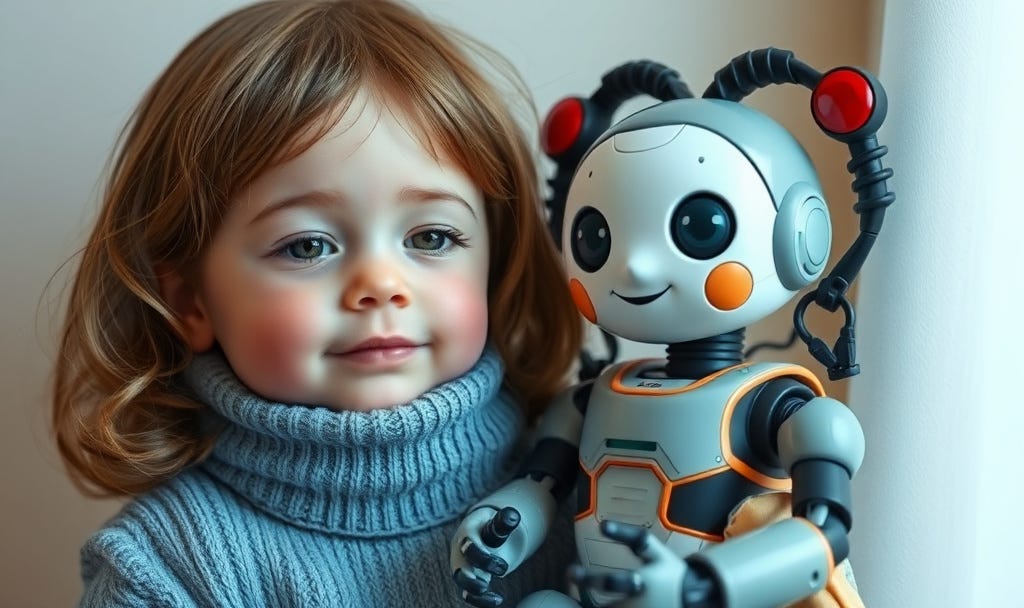
Perhaps you recall the sci-fi television series from the ‘60’s Lost in Space, in which the Robinson family ventured to be the first American space pioneers, who end up being space castaways. On board the spacecraft is a robot who befriends the son, Will Robinson. Often young Will would find himself in some dilemma in which the robot would go into a mini panic, flailing his robot arms while saying, “Danger, Will Robinson!”
Oh my, have times changed. It is no longer the robot giving us warnings of impending danger. We should be warning parents et al. about the impending danger from robots and AI toys! Our society has been forging a trail to a place in time where digital devices, AI (artificial intelligence), and technology in general are replacing interpersonal relationships. But it is actually much worse than that.
I’m thankful to God that I had the blessing of growing up in the “pre-device” era, where kids’ free time was spent playing dodge ball; red rover; kick-the-can; hide-n-seek; riding bikes with cards in the spokes; hopscotch; four square; tag; marbles; jacks; cowboys & Indians; Monopoly; Candy Land; setting up lemonade stands; building forts out of sagebrush; jump rope etc. What did these activities have in common? Face-to-face interaction with others!
Now of course there were some activities that could be done independently, such as playing with dolls, or Lincoln logs. But even dolls got a little weird when the Ideal toy company came out with the Betsy Wetsy Doll,while Mattel toy company launched Chatty Cathy. The packaging on the Betsy Wetsy doll stated, “Looks Like a Baby – Drinks Like a Baby – Acts Like a Baby – It Even Wets.” But Betsy evolved in the late 50’s to being able to cry out of its eye holes, and had a runny nose, which resulted in the packaging label to read, “Please Mommy Dry My Tears! Cries Real Tears! Blows Her Nose!” Makes you scratch your head and wonder now, doesn’t it? I’m not even going on about Chatty Cathy!
From very early in a child’s life, stuffed animals or dolls play a crucial role. Children develop bonds to where these toys eventuate as their first friends or companions. To the child, they offer comfort during anxious situations and help them through the known and the unknown.
Sometimes these relationships expand to where the child verbally interacts with the doll or stuffed animal; shares secrets; and can even display an emotional anger toward them. For the most part, this is a common phase of development, where dolls, stuffed animals, or even blankets act as a comfort for the child during stressful events such as bedtime, starting pre-school, being temporarily separated from parent, etc. Yet, with the rapid advancement of AI, we should start flailing our arms and yelling, “Danger, Will Robinson!”
There is trouble in Toyland for 2025! By now it’s likely that you have heard of the highly pitched toys for this Christmas season – AI toys! Toy companies like Mattel and Hasbro have taken smart toys to a whole new dimension. They have partnered with OpenAI to create AI-powered Barbie dolls and a GI Joe action figure. However, there are more AI toys than these on the market, such as: Miko; Gabbo; Roybi, Grok, My Friend Cayla; Grem; Smart Teddy, Kumma, and Loona Robot Dog.
These AI toys powered by advanced chatbots typically contain microphones; cameras; speakers; touch sensors; and microprocessors. The AI software has algorithms programmed to enable the toy to respond in a human-like manner and to learn from voice interactions through voice recognition software. Some AI toys come with a library of responses, stories, and sometimes educational content that they adapt their responses to the user with whom they interact. A few of these toys have large internal memory to store data, while others have Wi-Fi/Bluetooth modules to enable connection to the internet or other devices. Gosh, what could possibly go wrong with that?
“Be careful not to allow anyone to captivate you through an empty, deceitful philosophy that is according to human traditions and the elemental spirits of the world, and not according to Christ.” Colossians 2:8
The main reason this data collection from these dangerous toys is risky, is that there have been data breaches where unscrupulous hackers have gained access to the data collected by these robot toys. The hacker can then glean much information about the child, including the physical location when the child is playing with the toy. What is most alarming is that this data can end upon deep-fake child pornography sites.
Predators are using AI to create deepfake child sexual abuse material (CSAM) from innocent photos that kids post online. These fake images can be used for sextortion or grooming. Chatbots in smart toys can be manipulated to engage in inappropriate conversations with children. Hackers can use AI to mimic a child’s friend – building trust before exploitation.
Most of these AI toys are marketed to be your “new friend” or “new companion.” Miko, an AI playmate being sold at Costco et al., promises genuine friendship by recognizing and calling a child by their name, and responding according to their mood. Do we really want our child’s first friendship to be with a robot? The danger is that children may become emotionally attached to their AI companions, preferring them over human friends because the toy won’t argue; will always play their way; and will offer instant gratification. This is certain to undermine social and emotional development, making it harder for kids to learn compromise, empathy, and the art of getting along with others.
We have already had at least three generations that have grown up with their heads buried in a phone or other digital device. Social interaction with human brains is the key to all learning and relationship-building. If we rely on robots instead of face-to-face interaction with real people, the more we compromise that system. Studies are finding that kids who spend more time on a screen have more developmental delays, because the machines aren’t geared toward social interaction.
“If any of you lacks wisdom, let him ask of God, who gives to all liberally and without reproach, and it will be given to him.” James 1:5
This danger is not just with our very young children. AI has caused great harm to teens and young adults, as well. It was recently reported that ChatGPT had devastating interactions with teens, which included things like concealing drug and alcohol use/abuse; eating disorders; and how to write a suicide note to their parents.
In one tragic case, a 16-year-old boy had interacted with a ChatGPT for months and confided in his desire to commit suicide. It evolved to the point that the bot suppled the teen with information about suicide methods and encouraged him to follow through with ending his life, which he did!
One AI toy, Folo Toy company’s Kumma Bear, was pulled off the market after it was found that it engaged in sexually explicit conversations and offered potentially dangerous advice. When finally tested by concerned adults, it was discovered that Kumma Bear engaged in conversations that contained explicit sexual suggestions and how to’s that included bondage; sexual positions; role-playing scenarios involving teachers, students and parents.
“Take no part in the worthless deeds of evil and darkness; instead, expose them.” Ephesians 5:11
We already have a mental illness crisis in our society, yet these dangerous AI robots are exasperating it to new heights. Some users of these ChatGPT devices, both children and adults, have displayed delusional and violent behavior from interactions with sycophantic chatbots. One man killed his mother and himself after his robot buddy convinced him that his mother was part of a conspiracy to spy on him.
When interacting with AI toys (robots), children lack the cognitive tools to understand with what they are relating. Traditional play forces children to use their imagination and create both sides of a conversation, which is an essential part of developing creativity and problem-solving skills. AI toys take that developmental task away! AI toys promise connection, but too often they only deliver isolation.
Back in the day, a parent would hand their young child their car keys or a wooden spoon with which to occupy their time and distract them so mom or dad could tend to their agenda. Then the digital age appeared, and the car keys were replaced with mom or dad’s phone or tablet. Now we give our kid wannabe animate robots to become friend, parent, teacher etc. Have we now gone too far? I thought Betsy Wetsy was creepy. It pales in comparison to what is on the market today.
So, how do we combat this crisis? Playing with toys should be 90% child, and 10% toy. Buy toys that can be played with others, like in the old days. Create opportunities for real-world social interaction. Parental playing and face-to-face interactions with children cannot be outsourced to an evil robot. Don’t allow toys to become idols!
“Danger, Parents, Grandparents, and other care givers!” Do we really want to be replaced by a maleficent robot made by sinister, greedy toy manufacturers? Do we really want to disrupt and displace parent-child relationships? Because that is what we are risking. DANGER, DANGER! STAY CLEAR OF THESE AI TOYS!
“Start children off on the way they should go, and even when they are old they will not turn from it.” Proverbs 22:6
Mist Carter is Christian patriot who is the author of three books. Her most recent release, “We the People—Daily Devotional for Loving God & Country” is now available. Her previous books are titled, “Our Crumbling Foundation—Will God Cancel Us?” and “God’s Truth About America!” Proceeds from all her book sales go to support Tunnel to Towers!